 Career Malls Latest govt jobs, government jobs, job description, career builder
Job creation (In France):
On average, existing businesses destroy jobs. This is not the result of the crisis but is observed over long periods and in different countries. If the net creation of jobs is positive, it is only through the creation of new companies. Compared to the Anglo-Saxons, job creation by new firms in France is particularly weak.
France jobs article 2017
The importance of new firms to job creation has long been recognized by the Kauffman Foundation, an American foundation specializing in entrepreneurship. The essence of his discovery is summarized in the graph below, published a few years ago. This graph gives light blue job creation by new companies and in dark gray the change in jobs (positive or negative) in existing companies. It can be seen that while the number of jobs created in new enterprises is stable and significant, about 3 million per year over the last 25 years, the variation in jobs in existing firms is not only unstable on average but negative: over the period, Existing businesses have destroyed an average of 2 million jobs each year.
No job creation without new companies:
On average, existing businesses destroy jobs. This is not the result of the crisis but is observed over long periods and in different countries. If the net creation of jobs is positive, it is only through the creation of new companies. Compared to the Anglo-Saxons, job creation by new firms in France is particularly weak.
The importance of new firms to job creation has long been recognized by the Kauffman Foundation, an American foundation specializing in entrepreneurship. The essence of his discovery is summarized in the graph below, published a few years ago. This graph gives light blue job creation by new companies and in dark gray the change in jobs (positive or negative) in existing companies. It can be seen that while the number of jobs created in new enterprises is stable and significant, about 3 million per year over the last 25 years, the variation in jobs in existing firms is not only unstable on average but negative: over the period, Existing businesses have destroyed an average of 2 million jobs each year.
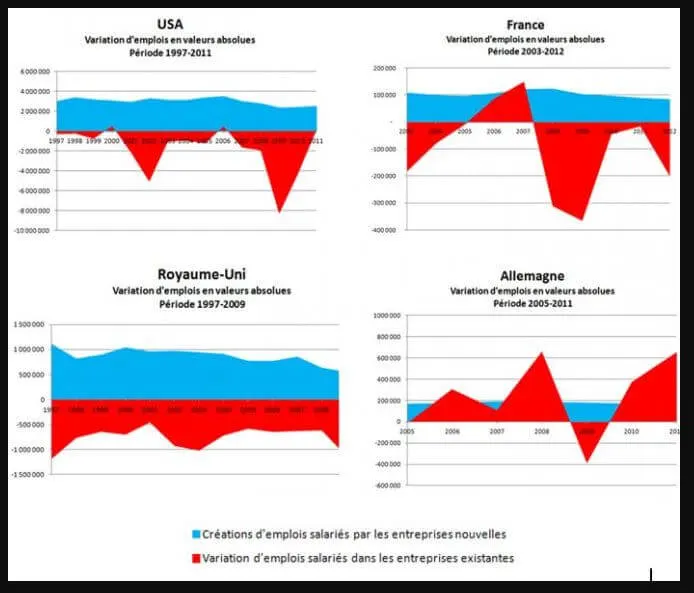
Following the Kauffman, the IRDEME Institute produced the same charts for France, the United Kingdom and Germany, and updated the data on the United States. It shows that Germany (bottom right) differs but that the Kauffman’s statement for the United States is true in France and the United Kingdom. Since GDP growth rates are not on average higher than in other countries, its difference is a distinct structural characteristic.
The graphs are presented below for the maximum periods available for each country. In blue appear job creation by new firms, which are very stable in any country, and in red appear the variations of jobs in the existing companies, which on average are very negative.
It is striking to note that new companies in France create particularly few jobs compared to new firms in our neighbors. In addition to the data presented in the graphs above compiled by the IRDEME Institute, this fact is confirmed by Eurostat statistics [1], which also confirm that new firms in France create 2 to 4 times fewer jobs Germany or the United Kingdom. The French news companies create less than 100,000 salaried jobs a year when German companies create about 200,000 and the British nearly 500,000.